Main Ridge House
Nestled among the rolling hills of Victoria’s Mornington Peninsula, Main Ridge House stands as a testament to the enduring power of collaboration and the timeless appeal of authentic Australian architecture.
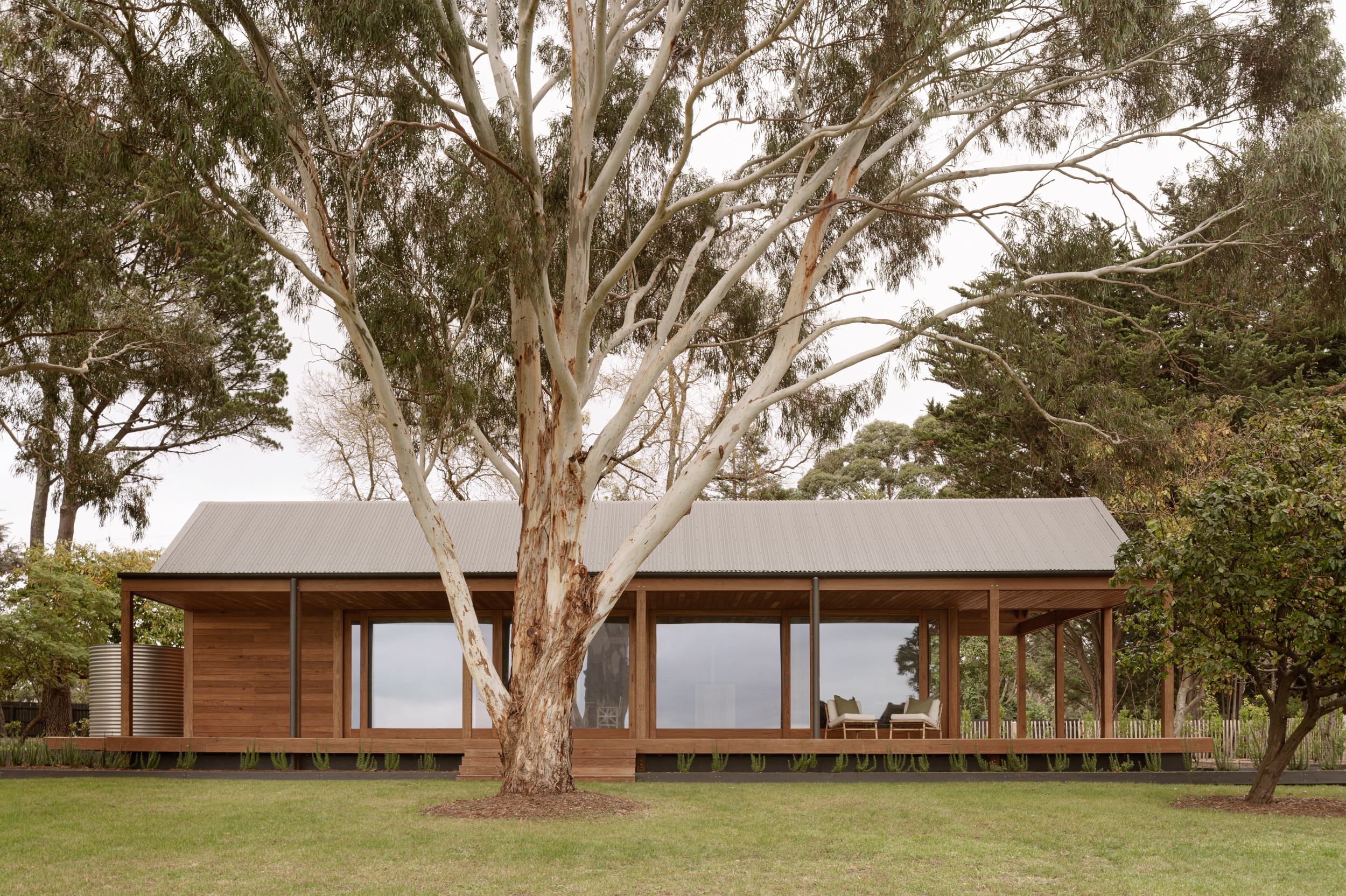
Designed by Porebski Architects for longstanding clients, this timber-framed residence serves as both a second home and a thoughtful companion to the family’s newly acquired vineyard.


The relationship between architect and client spans two decades, beginning with the conceptual development of their primary Portsea residence and evolving through the creation of smaller-scale structures across their winery property. This rich history of collaboration cultivated a shared appreciation for timber’s inherent warmth and connection to the land, ultimately informing the design philosophy of Main Ridge House.
Responding to the clients’ desire for a true country residence, the architects have crafted a composition of two distinct pavilions. The living pavilion faces the vineyard, housing the kitchen and communal spaces, while the front pavilion accommodates bedrooms, media areas, bathrooms and a practical mud room. Both structures are elevated above the ground, with the living pavilion dramatically cantilevered over an enclosed bushfire wall, generating a sense of lightness that allows the building to appear to float above the landscape.
A carefully orchestrated sequence of spatial experiences unfolds as one moves through the residence. In the entryway, the timber theme is established with a tongue and groove ceiling treatment, punctuated by twin skylights that draw natural light deep into the interior.
The journey towards the living area involves compression through a small linkway before expanding into the soaring volume of the main pavilion. The architectural language celebrates the structural properties of blackbutt timber, sourced locally and employed throughout the construction from frame to finish. Exposed columns and beams support a soaring collar-tied roof, cascading down into expansive glazing that frames views of the vineyard. Ship-lapped boards line both walls and ceiling, establishing a cohesive material palette that emphasises timber’s natural character.
The bedroom pavilion adopts a contrasting construction approach. Here, timber boards cover the structural framework, while plasterboard linings follow the steeply raking ceilings to cocoon the sleeping spaces.
The external verandas reflect the Australian architectural vernacular while providing crucial transitional spaces between interior and landscape. These covered outdoor areas reduce the apparent scale of the lofty interior volumes, fostering intimate environments that celebrate the property’s natural setting.


Located on the site of the existing house to minimise disturbance to the landscape, Main Ridge House represents more than architectural achievement – it demonstrates the profound rewards of collaborative design built on creative trust and shared vision.
Architecture by Porebski Architects. Build by Old Man Pine. Landscape design by Kate Ardlie Design. Structural engineering by Fitzgerald & Associates.