Pine Island Cottage
Pine Island Cottage by Bureau Tempo and Thom Fougere Studio is a dwelling that holds memory, welcomes charming patina and offers a tactile connection to its location.
Located in Georgian Bay, Ontario, and accessible only by water, Pine Island Cottage is a finely attuned response to place. Designed collaboratively by Bureau Tempo and Thom Fougere Studio, with architecture by Gren Weis Architect & Associates, the family retreat embraces the rugged serenity of its environment. The interior is both raw and refined, drawing on the rich textures of the natural world to create a truly tactile experience.

Following the footprint of a former cottage that had fallen into disrepair, the home was conceived slowly, not from a fixed brief, but through an ongoing, open-ended conversation. “We spent about a year with the architecture, sculpting it from the inside out, informing the interiors and the design at the same time,” says designer Thom Fougere. “There was no specific brief. The project really unfolded through close dialogue with the clients over four years. When we visited the site in the summer, we were walking barefoot on the island, which is predominantly stone sloped into water. We thought, ‘Is there anything better than this?’ So our approach was to somewhat replicate that tactility and rugged nature within the space while giving it an enriching experience.”
The emphasis on feel, material honesty, texture and connection to land runs throughout the interiors. Arrival is through an oak-lined entry that has a warm, cocooning effect. From there, a layered material narrative begins to unfold. Burnished concrete grounds the main living spaces, while locally sourced flamed Eramosa stone appears across stair treads to bathroom floors, echoing the island’s weather-worn granite.
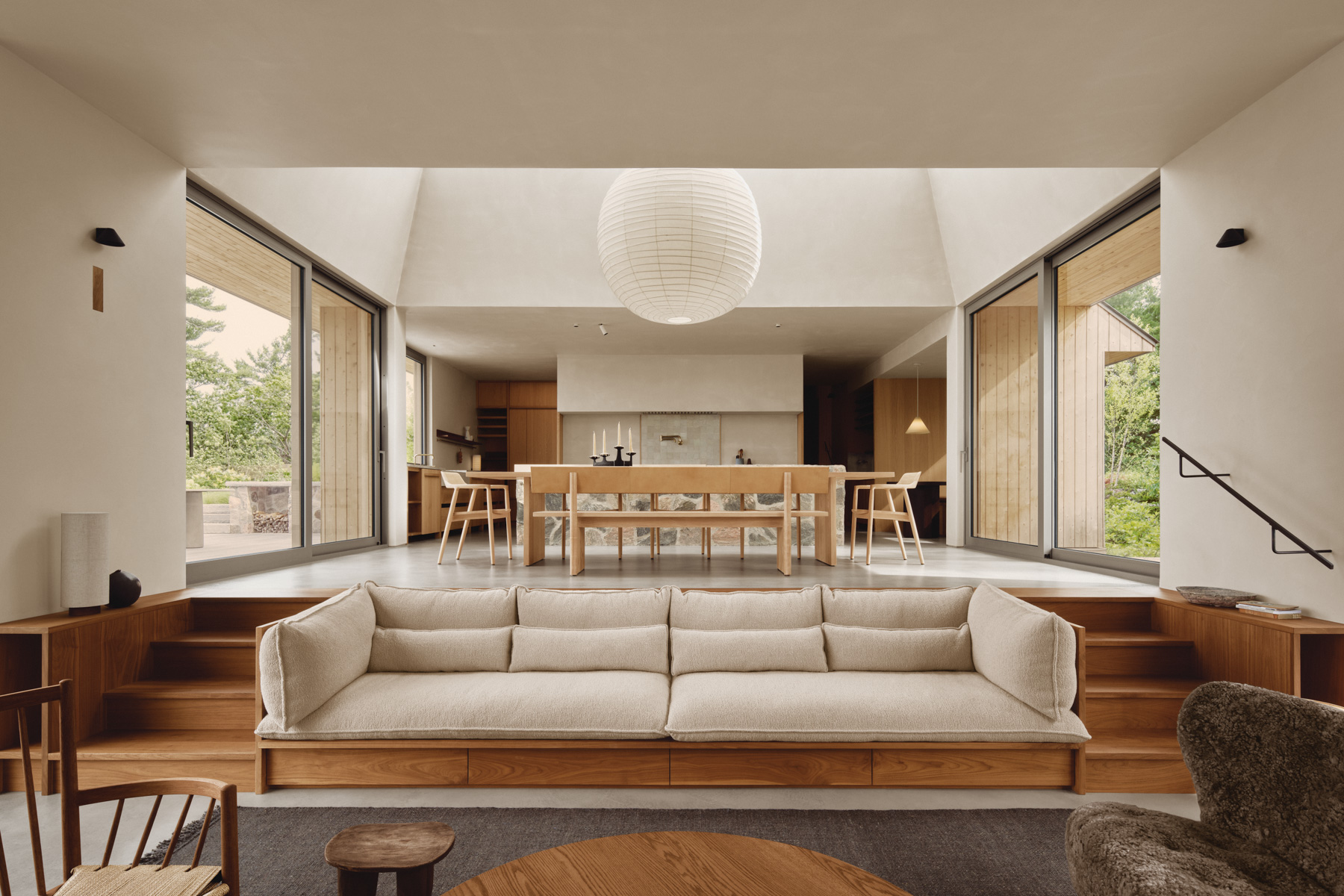
The open-plan layout follows the natural slope of the island, gently cascading from kitchen and dining to a sunken lounge. Each zone feels distinct yet continuous, guided not by partitions but by shifts in view, light and elevation. “There’s a strong visual connection between kitchen, dining and outdoor spaces,” says Adam Robinson of Bureau Tempo. “During the day, everything’s open, the kids are running in and out of doors beside the dining table and openings flanking the fireplace. The house becomes really porous with lots of openings. It’s a very fluid, dynamic space.”
At the centre of this flow sits two elemental anchors, a monolithic kitchen island and a fieldstone-clad, double-sided hearth. “The stone of the island and the hearth create these gathering nodes,” explains Robinson. “They’re sculptural but also practical, a place to prepare food or to gather around at the end of the day.” Openings on either side of the fireplace lead to a porch, where the hearth also provides warmth on long evenings.
The kitchen island is part butcher block, part stone monolith, surrounded by a sculptural perimeter of custom oak, walnut and limestone cabinetry. Adjacent to the kitchen, a reimagined pantry functions as a kind of indoor farmers’ market, lined with custom walnut boxes. “You can remove them, bring them to the island to prepare food or use them at the nearby bar to serve drinks, fill them with kids’ toys or take them on the boat,” says Robinson. “They travel across the cottage but always have a home.”
Throughout Pine Island Cottage, furniture and interior architecture are deeply intertwined, a result of the close collaboration between the studios. A timber dining table overlooks the sunken living room, while a built-in walnut sofa sits near the hearth. Many of the pieces were custom-designed by local craftspeople, from the pebble-shaped door handle to cast wall sconces, wrought iron handrails and drawer cutlery inserts. The studios also sourced every detail: ceramics, cookware, cutlery, bed linen and more.
The cottage’s most private spaces are accessed via a glazed breezeway. In the primary bedroom, one wall is lined in oak, while the opposite features custom wardrobes framed in blackened steel and faced in handmade woven rug panels for softness and acoustic dampening. Behind the bed, fieldstone reappears, offering continuity and weight. The ensuite continues the sensory language with a carved stone double sink, Eramosa stone shower floor and a deep ceramic soaking tub. “There’s something really elemental about bathing. It’s something we talked about a lot,” says Fougere. “Being embedded in nature while bathing but feeling safe; it’s the perfect combination. We had the stone torched and flamed so that brittle parts chipped away, creating a topography that replicates the natural stone outside, so you get that same feeling underfoot.”
That interplay between nature and shelter, ruggedness and comfort, animates every decision. Many of the materials were selected for how they wear over time. “There was a desire to choose materials that age well and capture signs of life,” says Robinson. Everything you touch – the porous stone used for basins and sinks, the pewter bar that scratches easily and the soft Douglas fir dining table that shows marks from the kids using their forks – was chosen deliberately to embrace patina and age.”
Perhaps the most poetic is the way Pine Island Cottage absorbs its surroundings and captures the changing exterior conditions. The interior plaster subtly shifts in tone, green with the canopy in the morning, blush with the sunset in the evening. “When you’re in front of the fireplace, you can see that the concrete floor is almost level with the stone outside,” says Fougere. “Many colours from outside come inside, and it feels connected and comfortable. Those were two things we worked hard for.”
Architecture by Gren Weis Architect & Associates. Interior design by Bureau Tempo and Thom Fougere Studio. Build by Coulter Dawe & Associates. Landscape design by John Lloyd & Associates. Lighting by &Tradition, Artemide, Audo Copenhagen, Flos, iGuzzini, Marset, Santa & Cole and Vitra. Kitchen tapware by Vola.