Tom Dixon
Restless, rebellious and eternally inquisitive, Tom Dixon has created a globally resonant design portfolio marked by irreverent humour and a distinctly hands-on approach to production.
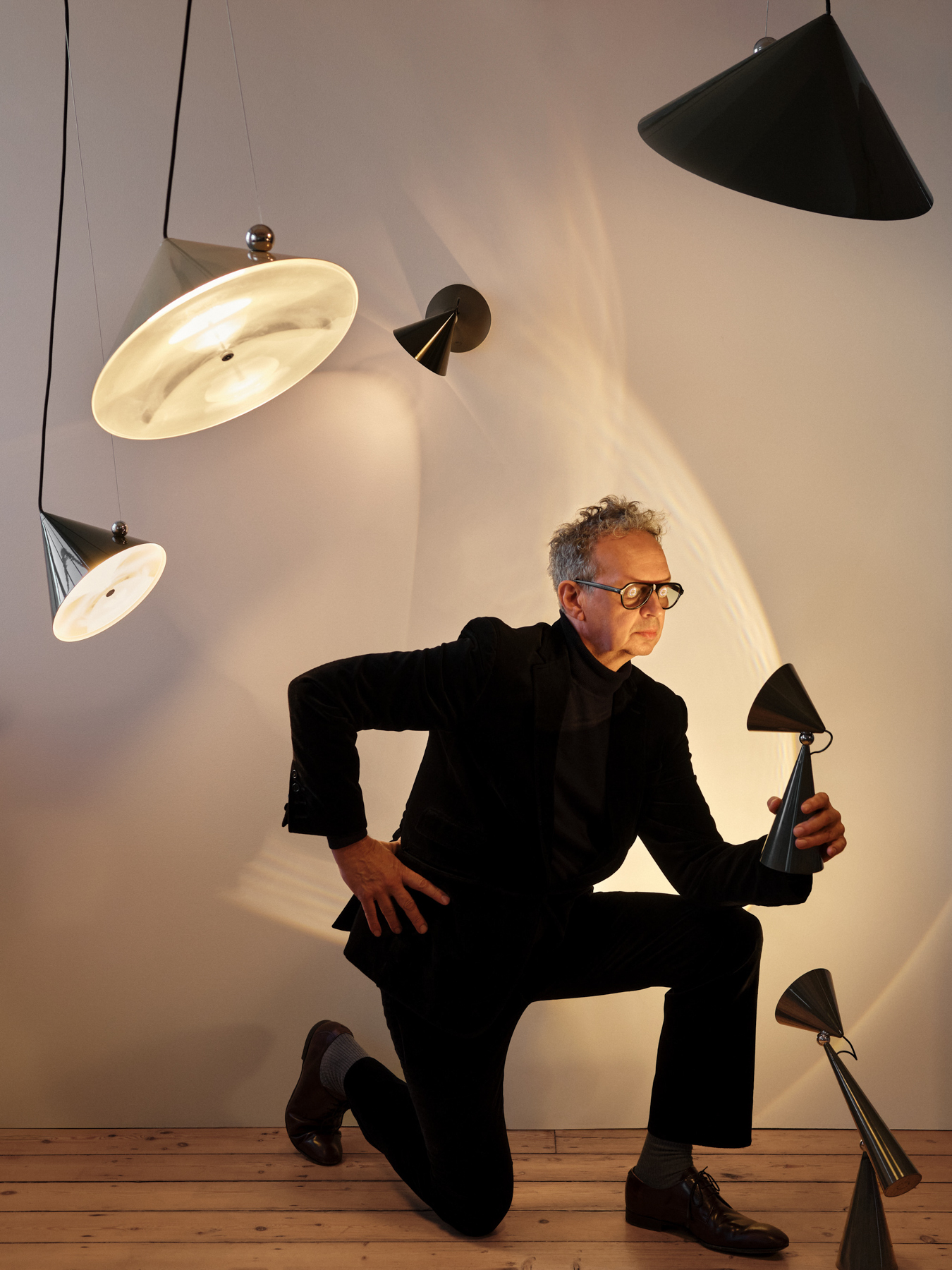
That British designer Tom Dixon would end up in a creative field was inevitable, but the road to furniture and lighting design was a winding one, with many a formative pit stop along the way. “It was happenstance in a way, but I’m a firm believer in making your own luck,” he says. “By being active, being interested, being curious and getting on with it, things come to you.”

Among the foundational adventures, there was work as a printer; the job hand-colouring cartoon animations; the short-but-successful music career with the band Funkapolitan, which he is characteristically modest about (“Everybody had a band. I was the last to pick the instrument, so I got the bass”); and, following the motorcycle accident that ended his music career, the newly discovered passion for welding.
Beginning with repairing motorcycles, this self-taught skill saw him swiftly move on to welding scrap metal into sculptural pieces that walked the line between art and functional design. “I would have been very happy being a sculptor, actually. But the frame of functionality [inherent in design], that departure point, stops that ‘blank piece of paper’ feeling.” While utility gave his artforms a purpose and conceptual framework, he says, “I think I was actually more inspired by the art world than I was by design, and I actually came to understand that I was a designer much later on.”
In the eyes of the public, at least, that point came with the S chair, a seamlessly undulating form in varnished metal and hand-woven rush, which marked a career breakthrough for Dixon and a transition from local to international success when it was picked up by Italian design house Cappellini. From there, he spent 10 years as creative director of Habitat, revitalising the British homewares company, while also gaining invaluable knowledge of the commercial side of design. In the middle of his Habitat tenure, he launched his eponymous brand, under which he could achieve the autonomy he craved and, most importantly, reconnect with the entire process of creation, from ideation to manufacture and beyond.
This holistic approach to design is a defining feature of Tom Dixon – the person and the brand (even now, the product design side of his business consists of a minimalist team of two, including himself ), with his furniture and lighting products embodying his fascination with materials and the transformative process of manufacturing. “I think it was clay that started me off, because we had a great pottery department at school – clay is so formless and ugly in its natural state, and then you put it through these processes to make it shaped and hard, glazed and coloured. There I learned the beauty of processing materials.”
Though the Tom Dixon empire has come a long way from those early days of solo welding, the brand still reflects the hands-on nature of the scrappy, self-taught and experimental designer. Most notably, in the rarity of owning the manufacturing process, which Dixon says keeps the company grounded in practicality. “Unlike most other design studios, we put our things into production, and we have to solve the problems of how it functions and what the materials do before they break, become dirty or scratched. Our everyday nightmare is materials and I really like that as a departure point.”
The material landscape of Dixon’s creations is ever evolving, as this eternally curious creator experiments with an enormously broad range of substances: the known and the new. Among the latter, he has played with mycelium for a prototype chair created with Magical Mushroom Company; Biorock, with chairs and tables ‘grown’ underwater from mineral deposits accumulating on electrified metal; and cork, in a pleasingly podgy range of charred cork tables and stools. More familiar materials – metal, glass, fabric – are playfully contorted. As in the molten glass effect of the iconic Melt pendant lights, or the Groove range of outdoor furniture, which bends aluminium into whimsical, Art Deco-inspired shapes.
With a portfolio spanning more than 20 years and driven by inexhaustive inquisitiveness, the Tom Dixon product range is impossible to condense into one word or theme. Nonetheless, there’s a common thread through his oeuvre, a distinctive look that combines simplicity with irreverence. Functionality with a wryly arched brow, perhaps. Within his most recent work, Dixon identifies a distinct leaning towards more rounded shapes and what he describes as ‘corrugation’.
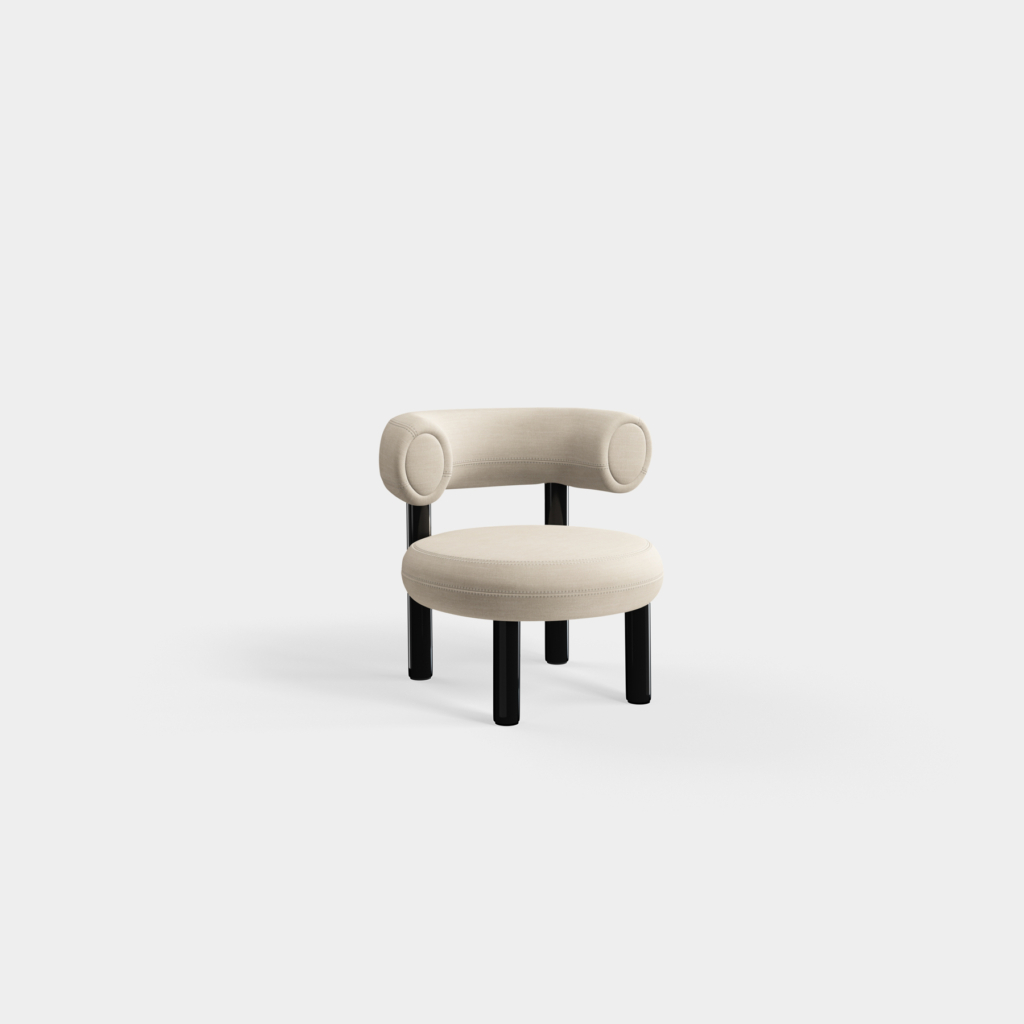
“That strong stripe you see in fashion is a three-dimensional stripe in our Press lighting and Groove outdoor furniture. It’s so universal – you see it in a Japanese raked garden or in a vinyl record.” Similarly, he sees a similar typology of shapes between the above products and others, including the generously curved Fat chair and Fat collection of door handles for D Line. “There’s a commonality there. You can trace a very rounded, blown-up aesthetic – a bit Jeff Koons-like – in all those products.”

Other pieces have cemented the Tom Dixon brand as quintessentially British, with flamboyant shapes inspired by familiar English furnishings. Like the Wingback collection, a modern reimagining of the classic British 17th-century silhouette, or the Fan collection, which contemporises the classic Windsor chair. When asked about the brand’s innate Britishness, Dixon points out that he also has a French passport (he was born in Tunisia to a French-Latvian mother and English father). “I’ve got an escape route from being a British designer,” he laughs, but adds: “Without being too nationalistic, there’s something around the fact that [as a Brit], you have a unique DNA and a unique sense of humour and way of seeing the world.”
Perhaps as a side effect of his informal training, Dixon is a free-ranging creative. In addition to product design under the Tom Dixon label, he heads Design Research Studio, an interiors and experiential design consultancy that creates incredible spaces – restaurants, hotels, retail stores – across the globe, and which allows Dixon and his team to work in a broader range of aesthetics and with relative anonymity. The line between the studio’s work and the Tom Dixon brand is porous. “It’s very good for us to have a studio like that, because it contextualises our stuff and it acts as a breeding ground for product ideas. And it also acts as an amazing testing ground to see how robust the furniture is in use.”
Design Research Studio projects have accelerated products and birthed ideas that have gone on to become iconic Tom Dixon designs. The Wingback chairs created for boutique London hotel Shoreditch House are one example, while, on the other side of the world, the Melt light first appeared in the redesigned Bennelong restaurant at the Sydney Opera House, where it was mounted on a post due to site limitations. “A pre-release, effectively. And then, when we got back to the UK, we turned it upside down, which I always find very funny. The Down Under thing was actually symmetrical – in the UK, it’s a chandelier and in Australia, it’s a lamp post.”
Dixon has truly earned his status as a design doyen, and shows no sign of stopping any time soon. “I’m never really satisfied, I’m quite self-critical and I would always want to improve [a design] to version 2.0,” he says. “It’s not normal to do that in our industry, you know, striving for perfection of the icon or whatever. But if you were in software, you would never stop and stand still and be satisfied. There will always be improvements to be made, right?”