Telly Theodore and Andrew Macdonald
Designed by Telly Theodore and Andrew Macdonald of Allied_Office, Blackwattle House was a once-derelict Victorian cottage that now plays on contrast and curiosity.
Unfolding down a slope, Blackwattle House rests between two contrasting faces – one, a modest and unassuming Victorian facade, the other, a contemporary concrete and steel form. Neither reveals the extent of the spatially generous house within; instead, the contrast piques a sense of intrigue.




The steep site is a common condition in Sydney’s inner suburbs, where sandstone ridges meet the edges of the harbour. Here, in Glebe, on Gadigal land, the ground shifts and falls away toward Blackwattle Bay. With narrow streets lined by 19th-century terraces and workers’ cottages, dotted with the occasional modern apartment block, the architecture of the surrounding area reveals its layered history and informed Allied_Office’s approach to the project. “Glebe, of course, is a heritage conservation area,” says Theodore. “In fact, it is the place where our conception of retaining what is good in old things was instigated, as part of the fight back against cancerous development and ridiculous road systems touted in the ’70s.”
The existing house on the site was built sometime between 1890 and 1900, likely by the same builder as the neighbouring terraces. Theodore says, from the street, “the house presented as it always had.” However, over the last century, everything other than the front facade had been heavily altered. This lack of continuity allowed the architects to have some flexibility when reconfiguring the house. With the council requiring only the street elevation to be retained, the architects had “over 90 per cent of the site to cook up ourselves”.



Allied_Office approached the design of Blackwattle House with what Theodore describes as an “inexplicable and intuitive understanding of the site” – a sensitivity that shaped the project from the beginning. It was challenging from the outset – not least because when Theodore and Macdonald purchased the house, “it was in a complete state of disrepair – the only thing worth saving being the entry and its room facing the street. The rest was very much a clogged artery spilling over a series of convict-era sandstone excavations near the harbour’s edge. No one wanted it.” Responding directly to the topography, layered sandstone and remnants of previous excavations, “the complete reconfiguration only becomes evident as you descend down a new stair into an unexpectedly generous and light-filled space.”
To bring light down to the lower ground floor, the front garden was excavated right up to the property line while leaving “a bridge” from the street to the front door. This lower-ground floor was conceived as an enfilade: a sequence of spaces that step down the slope, subtly shifting in level to define each area. “The different living zones spilling over to a cobbled courtyard, culminating with a studio above a garage, was a clear diagram right from the outset,” explains Theodore. The experience of the house is shaped by the careful calibration of thresholds, textures and views. The aim was to “string together a sequence of spaces into a coherent and comfortable whole”, which, for Theodore and Macdonald, echoes the ethos of their practice, “in so much as making things appropriate and as best as they can be in whatever means we have been given”.


Opening to the light well on the southern side and the dining space on the other, the kitchen is anchored by a large marble-topped island bench. There is an elegance and timelessness to the material and colour palette – dark timber cabinets with brass fixtures feel contemporary yet not out of place with the house’s Victorian history. The dark-stained timber floor continues from the kitchen into the dining room, which sits between the stairs on one wall and a fireplace with built-in bookshelves on the other. A large, irregularly shaped table centres the space. Designed by the couple, the table can separate so that it can be large when entertaining, but when not in use, a quarter of it can be stored against the wall as a side table. This table – along with its arrangement and relationship with the other furnishings – highlights Allied_Office’s relaxed but considered interior styling. All of the furnishings in the home feel like they are in their place, and yet, at the same time, their composition is surprisingly delightful.
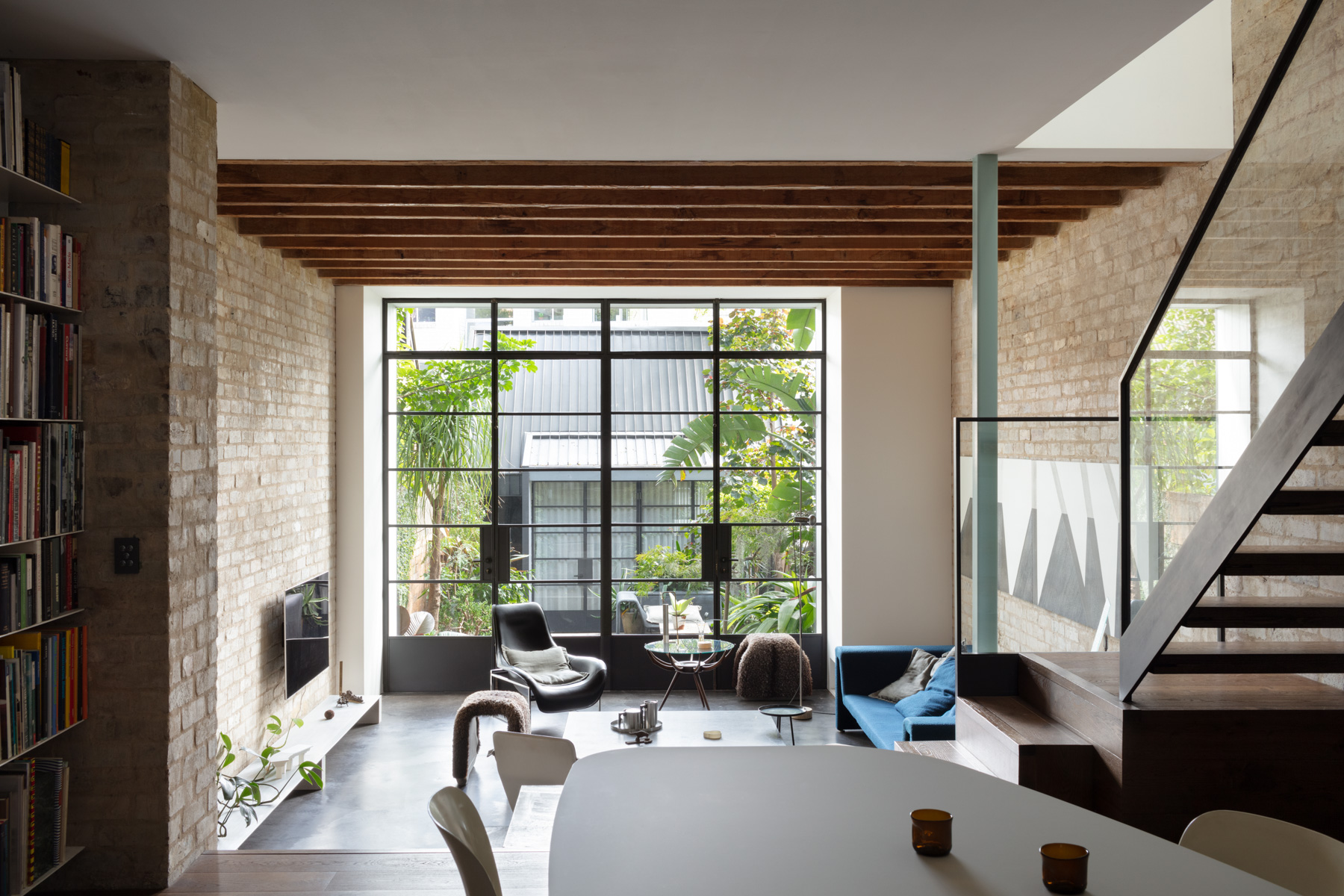
Stepping down from the dining space to the black oxide concrete floors of the living room, the house at first seems to open up even further. Large, full-height steel-framed glass doors create a sense of airiness, and northern light filters softly through the foliage outside, which casts shifting patterns across the polished floor. In the living room, looking out to the leafy cobbled courtyard with the studio beyond, there’s a quiet sense of retreat. From here, it seems as if the house acts as an oasis from the world, and despite the interiority of this perspective and the newness of these additions, it is entirely of this place. The warmth of exposed timber ceiling joists and the textured surface of the reused and French bagged bricks suggest the history of the house.



Across the courtyard, the studio comes into view, framed by the garden, completing the spatial diagram. The studio is, to some extent, an adapted reflection of the living room on the other side of the courtyard. With large, steel-framed glass doors, French bagged and white painted brick walls and black oxide concrete floors, the studio – the design office for Theodore and Macdonald – feels connected to the rest of the house. However, unlike the main house’s retained original walls, the studio and garage below are entirely new. The interior offers some hints as to the newness of this space, such as a folded, flat brass detail as the loft’s balustrade, but the addition’s new status is made most evident in the steel and concrete materiality of the street-facing facade.
The two main bedrooms and bathroom are back up the stairs of the main house, on the ground floor. While the walls downstairs are largely either white or bagged brick, colour is introduced in these rooms. The dark blue-green bagged brick wall in the primary bedroom, as well as the soft grey panelled walls and black tiled floors in the bathroom, create not only a different feel to the lower-ground spaces but also a sense of intimacy. Considered details such as custom brass curtain railings playfully extend and fold out from the windows that frame views of the leafy surrounds. Where the spaces on the lower-ground floor are defined by their interconnectedness, these rooms have a sense of completeness.
For Theodore and Macdonald, there was something about this project that was just meant to be. They were travelling when they first came across the existing house via “a very serendipitous email alert”. They had been having such a wonderful time abroad that they were contemplating moving further afield. “The universe, though, had its own plans,” recounts Theodore, “and in hindsight – as corny as it may sound – the house decided it wanted us.” While the house and site have had many lives before and after the construction, Allied_Office has reorientated the experience to create a comfortable, considered and elegant home that the couple describe as “the perfect place to live”.
Architecture and interior design by Allied_Office. Build by Constec Constructions and Cuzco Constructions.