
Void House
Light and Air reimagines a Manhattan brownstone, rotating its staircase to create a luminous central void, inviting natural light and creating a seamless, uplifting journey through layered spaces.
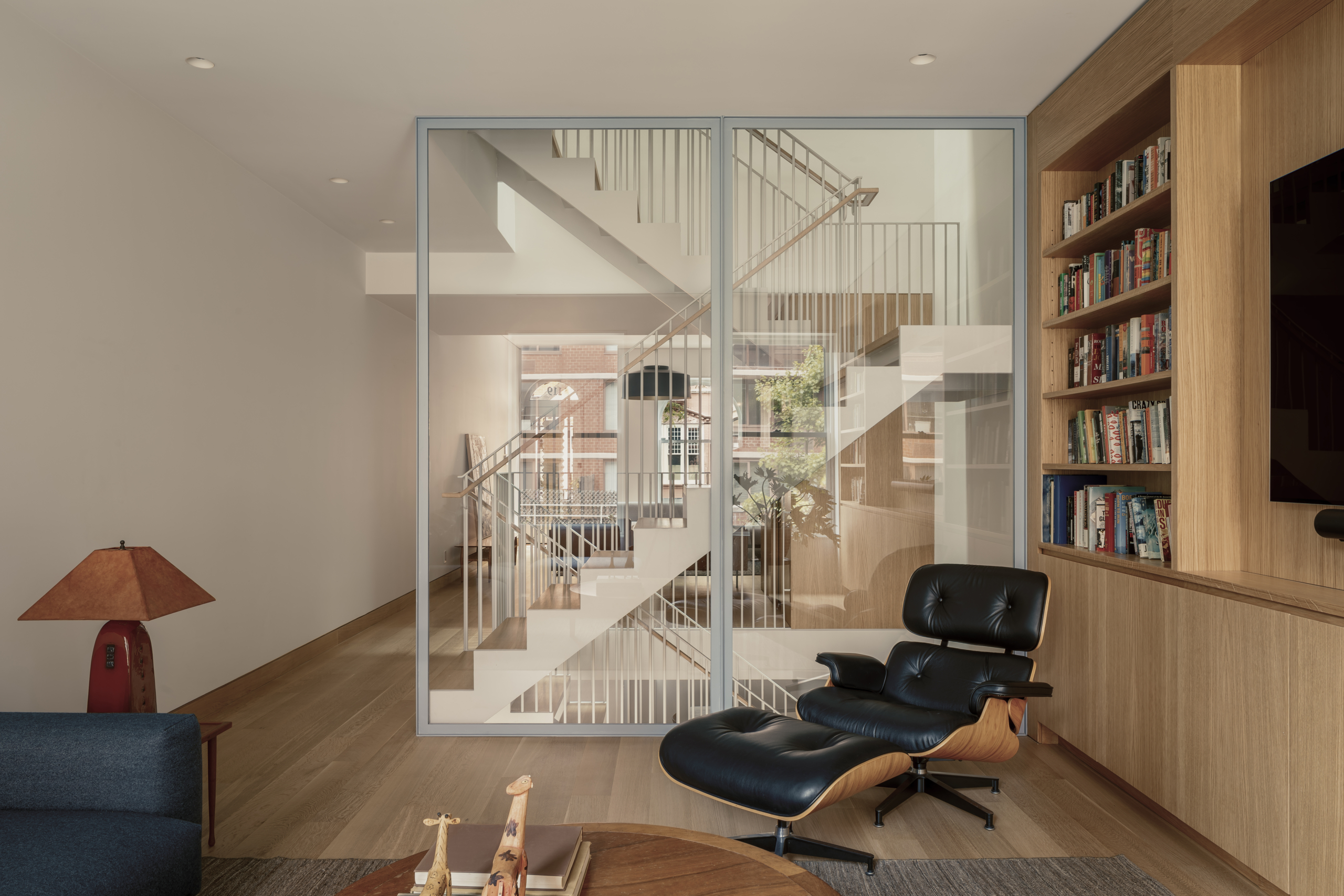
A typical New York City brownstone is characterised by its iconic stoop, narrow facade and warm-hued sandstone exterior, often punctuated by tall windows and classic 19th-century details. Many also feature a narrow period staircase perpendicular to the length of the building – a feature that New York City–based studio Light and Air considered more limiting than liberating, restricting how the space could be used. In designing Void House, a 300-square-metre brownstone in Manhattan’s Carnegie Hill neighbourhood, the practice rotated the rowhouse staircase ninety degrees, transforming it from a mere functional thoroughfare into the home’s pièce de résistance.

For a home only fifteen feet wide, the studio, helmed by architect and painter Shane Neufeld, had to arrive at an architectural paradigm that not only accommodated a staircase, but allowed it to take centrestage while also admitting natural light and ventilation. Neufeld devised a switchback staircase with split-level landings, all contained within a luminous central void overarched by a series of slanting skylights. By reorienting the staircase, the architect was able to create circulation areas on either side, each wider and deeper than before.
The staircase, constructed of steel and white oak, exhibits a crystalline elegance, with open risers and permeable guardrails that facilitate the uninterrupted passage of light from one level to the next, extending down to the garden. Natural light suffuses every room along the void’s central axis, creating an orchestrated interplay of air and illumination that animates the home’s spatial experience and emphasises the architectural clarity of each level. “The light from above was meant to create intrigue and mystery, drawing the visitor upwards to the sky. The rooms transition from public to more private as one ascends. At the very top, where the stairs culminate, is a bulkhead providing access to a luxurious roof terrace, buffered along the sides and with views outwards to the city beyond. The entire experience feels like a crescendo,” says Neufeld.


Where he highlighted the architecture, Neufeld restrained the decor, keeping it minimal yet inviting and warm. His approach emphasised the natural light, treating it as an evolving work of art and exploring ways to keep it at the forefront. “With an abundance of natural light from the skylight above, the house’s interior is consistently illuminated, offering a variety of visual experiences throughout the day,” notes the architect, who complemented the soothing space with his own serene paintings. This philosophy informed a palette of materials and textures carefully chosen to complement the light without competing with it – or, as Neufeld puts it, “based on their sensitivity to light, and their ability to reflect it throughout the house”.
Neufeld approached the house as a cohesive whole rather than a sum of various parts. “There wasn’t a specific design intent for each room. The house was intended to be experienced gradually and collectively,” he says, admitting this was easier said than done. “Integrating a steel structure to accommodate the new staircase was incredibly challenging, prompting us to develop innovative solutions for engaging the existing brick masonry that supports the floor joists while coordinating the new steel stair with all the mechanical and plumbing infrastructure required in a modern home.” In the end, the effort paid off, resulting in a home where light, space and movement flow effortlessly, creating an experience that feels both heightened and harmonious.
Architecture by Light and Air.


